Know the Fiat rental rules for driving Sicily in style, from license checks and deposits to ZTL zones, parking, insurance, and scenic road planning ahead.
One stands high above the western Sicilian countryside, quiet and almost impossibly intact. The other spreads toward the Mediterranean in a vast ancient city of fallen columns, sacred temples, and sea-bright horizons. Choosing between Segesta versus Selinunte ruins is less about finding the “best” archaeological site and more about choosing the kind of day you want to remember.
For travelers based in Palermo, both destinations make rewarding excursions into Sicily’s Greek past. Yet their atmosphere, size, travel time, and visual character are very different. Segesta is compact, dramatic, and easy to pair with Erice or the salt flats of Marsala. Selinunte is expansive, coastal, and made for those who want to wander slowly through one of Europe’s great archaeological parks.
Segesta Versus Selinunte Ruins: The Essential Difference
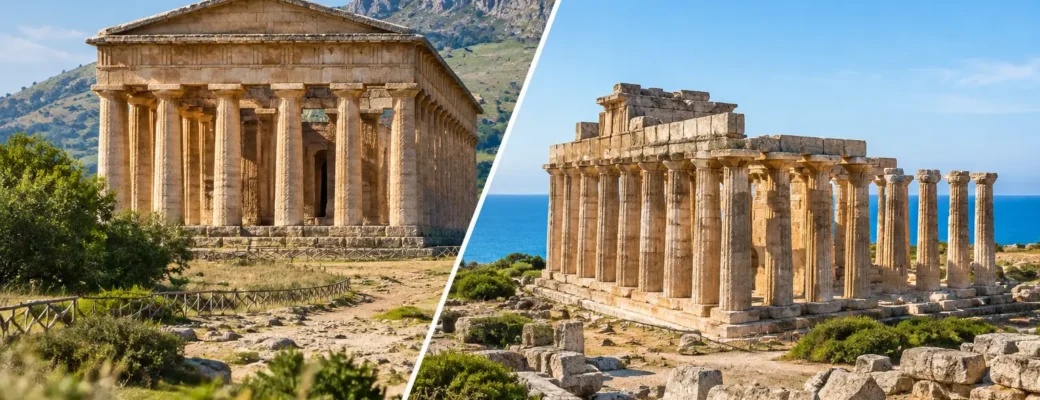
Segesta feels like a single powerful scene. Its magnificent Doric temple stands alone in an open valley, framed by rolling hills that still feel wonderfully untouched. Built in the 5th century BC by the Elymians, a people with close cultural links to the Greek world, the temple has never lost its spell. Forty-six columns rise from the landscape, and because the roof was never completed, visitors can see the structure’s pure architectural form with unusual clarity.
Selinunte, by contrast, feels like a lost city. Founded by Greek settlers in the 7th century BC, it became one of the most important and prosperous cities in ancient Sicily. Its archaeological park covers a huge area, with several temple groups, residential remains, defensive walls, and an acropolis overlooking the coast. Here, the experience is not centered on one perfect monument. It is about scale, imagination, and the thrill of walking through a place where an entire civilization once lived.
If you have time for only one, ask yourself this: do you want a dramatic temple in a beautiful inland setting, or a full-day journey through a sprawling ancient city by the sea?
Choose Segesta for Drama, Ease, and Hilltop Views
Segesta is often the better choice for first-time visitors to western Sicily, especially if you are staying in Palermo and want an archaeological visit that feels special without taking over your entire day. The site is roughly an hour from Palermo by private vehicle, depending on traffic and your starting point.
The temple is close to the entrance and immediately rewarding. You do not need to be an archaeology expert to appreciate it. Its setting does much of the work: green hills in spring, golden fields in summer, and wide skies in every season. It is one of those places where even a short visit can feel cinematic.
Beyond the temple, a shuttle takes visitors up to Monte Barbaro, where the ancient theater looks across the countryside toward the Gulf of Castellammare. The climb and transport add a little planning, but the view is worth it. During summer performances, the theater becomes even more memorable, connecting ancient architecture with live music and drama.
Segesta suits couples seeking a romantic escape, families who prefer an easier walk, and travelers with a tightly planned itinerary. It also works beautifully as part of a varied day trip. You can combine it with the medieval streets of Erice, a winery visit, or a scenic drive through western Sicily rather than spending every hour among ruins.
There is one trade-off: Segesta offers fewer structures and less sense of urban life than Selinunte. If your dream is to roam for hours through temples and archaeological remains, it may feel too brief on its own.
What Makes Segesta So Photogenic
The appeal of Segesta is its clarity. The temple is exceptionally well preserved, its columns stand in full formation, and there are few modern visual distractions around it. Morning light gives the limestone a soft warmth, while late afternoon brings longer shadows and a more dramatic mood.
Wear comfortable shoes even for this relatively manageable visit. The terrain is uneven in places, and the theater area is exposed to the sun and wind. Bringing water, sunscreen, and a light layer outside the hottest months will make the visit far more pleasant.
Choose Selinunte for Scale, Sea Air, and Ancient Sicily
Selinunte rewards travelers who want to slow down. From Palermo, it is generally a longer drive than Segesta, often around 1 hour and 45 minutes or more, but the journey leads to an archaeological landscape unlike any other on the island.
The park contains multiple zones, and distances between them can be significant. The eastern hill is home to the famous Temple E, a grand reconstructed Doric temple that offers Selinunte’s most iconic view. Nearby stand the remains of Temples F and G, where enormous fallen blocks reveal just how ambitious this ancient city was.
The acropolis delivers a different feeling. Its ruins are more fragmented, yet its position above the sea is extraordinary. Walk among old streets, fortifications, and temple foundations while the Mediterranean opens beyond the cliffs. It is easy to understand why this coastal location mattered to Greek settlers, merchants, and rivals.
Selinunte is ideal for history lovers, photographers, and travelers who do not mind covering more ground. It is also a wonderful choice for visitors building a southern or western Sicily itinerary around beaches, wineries, Mazara del Vallo, or the nearby white-sand coastline.
The trade-off is effort. Selinunte is large, often hot, and can feel overwhelming without a guide or a clear plan. An internal shuttle or golf-cart service can help when available, but you should still expect walking. In peak summer, an early start is much more comfortable than a midday arrival.
Why Selinunte Feels More Immersive
At Selinunte, the ruins do not sit apart from the landscape. They are part of it. Wild grasses grow between stones, sea breezes cross the acropolis, and birds move above temple fragments that have rested here for centuries. The site has a raw, open character that can feel more adventurous than polished.
It is also a place where restoration and ruin exist side by side. Temple E has been partially re-erected, allowing you to grasp its original grandeur. Other temples remain in dramatic collapse, their massive columns scattered where earthquakes and time brought them down. That contrast makes Selinunte especially compelling for visitors who want to see archaeology as an ongoing conversation with the past.
Which Ruins Are Better for Your Sicily Itinerary?
Choose Segesta if you have one free day from Palermo, prefer a relaxed pace, or want to combine ancient history with another western Sicily highlight. It is the easier choice for a half-day visit and delivers an immediate visual payoff.
Choose Selinunte if ruins are a main reason for your trip, you enjoy long outdoor walks, and you want the sea to be part of the experience. Give it at least half a day, and ideally most of a day if you want time to explore without rushing.
Travel style matters too. A private driver or guided excursion can make either destination simpler, particularly if you do not want to manage rural roads, parking, or limited public transportation. Sicily Tour Experience can shape a western Sicily day around the destinations and stops that matter most to you, whether that means temple views, a relaxed lunch, or a route that continues to Erice, Marsala, or a local winery.
When to Visit Segesta and Selinunte
Spring and fall are the sweet spots for both sites. From April through June and again from late September through October, the temperatures are generally kinder for walking and the landscapes are at their most beautiful. Spring brings green hills around Segesta and wildflowers across Selinunte’s open fields.
Summer offers long, bright days and a lively vacation atmosphere, but plan carefully. Start early, carry more water than you think you need, and leave time for a swim or a leisurely meal after Selinunte. Winter can be peaceful and atmospheric, although weather changes quickly and some visitor services may be reduced.
For photography, Segesta is especially beautiful in early morning or near sunset, when its temple glows against the hills. At Selinunte, late afternoon light enhances the honey-colored stone and makes the coastal panorama feel even more expansive.
A Small Choice With a Big Sicilian Reward
There is no wrong answer in the Segesta versus Selinunte ruins debate. Segesta gives you a perfect temple and a moment of stillness above the Sicilian hills. Selinunte gives you an ancient city, salt-touched air, and room to wander through history at your own pace.
If your itinerary allows, see both on separate days. Let Segesta be the elegant, unforgettable pause in the countryside, then give Selinunte the time it asks for: comfortable shoes, an unhurried afternoon, and enough curiosity to follow the old stones all the way toward the sea.
More to Explore